Rue Notre-Dame-des-Champs
A Moveable FeastRue Notre-Dame-des-Champs is the Paris street where Ernest Hemingway and Hadley Richardson lived in a flat above a sawmill at number 113. Its importance lies less in a single dramatic incident than in the life organized around that address: early-morning work, care for Bumby, meals made within a tight budget, and walks to nearby cafés. The street becomes a point of return in a city whose routes, work, and daily necessities continually shaped the narrator’s experience.
Home Above the Sawmill
The flat stood over a sawmill, with a courtyard where lumber was stacked. That working setting was part of the household’s immediate surroundings: after a day’s work, Hemingway could leave the flat, cross the courtyard among the piled timber, and reach the street. The location offered no grand separation between domestic life and labor; the sounds and materials of a working neighborhood formed the threshold between home and Paris outside.
The flat was also a place of practical care. One morning Hemingway woke early, boiled Bumby’s rubber nipples and bottles, prepared formula, and finished bottling before working at the dining-room table. Bumby and F. Puss, the cat, were his quiet company. The ordinary sequence of feeding a child and beginning work gives the address an intimate dimension: writing did not take place apart from family routine, but within the hours left by it.
Work and the Nearby Cafés
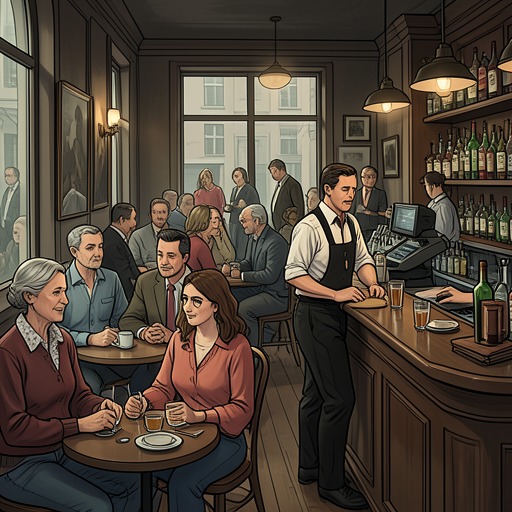
The Closerie des Lilas was the nearest good café to the flat and one of the narrator’s preferred places to work. Its setting changed with the season: warm indoors in winter, and in spring and fall pleasant at tables beneath trees or broad awnings. Hemingway knew two of its waiters as friends. Unlike cafés where people went to be seen, the Closerie was not a place where the familiar crowds of Le Dôme and La Rotonde gathered, or where patrons would have stared at them. Its comparatively unshowy character made it a working extension of the neighborhood rather than a public stage.
The street also lay along a route between the cafés and home. After an afternoon at the Closerie, Hemingway could take the shortest way back by Rue Bonaparte, Guynemer, and Rue d’Assas, continuing up Rue Notre-Dame-des-Champs. On one such working afternoon he wrote in a notebook over a café crème, developing a story about returning from war without mentioning the war itself. The nearby streets and café tables were not merely scenery: walking and sitting in them helped structure the time and attention he gave to work.
The connection between home and café was reciprocal. The flat offered a table and the quiet company of Bumby and the cat; the Closerie offered a warm, familiar place to concentrate. Mr. Lavigne, proprietor of the Nègre de Toulouse restaurant, had seen Hemingway working early at the Closerie terrace and later remarked on the absorbed, solitary air he had there. The comment captures how visible the discipline of writing could be to people who encountered him along his neighborhood routine.
Domestic Economy and Shared Life
The address belongs to a period when money governed choices without, in the narrator’s account, defining the couple as poor. Their habits were economical: they ate and drank well for little, and treated shared warmth and affection as more important than the conveniences they lacked. The account also acknowledges the narrator’s severity about spending and his recognition that he had been wrong to resist buying Hadley Richardson a grey lamb jacket. The rue Notre-Dame-des-Champs setting is part of this domestic world, where work, household needs, and the decisions of a marriage met at close range.
Their plans could be modest and intimate. Rather than spend money eating out, they imagined coming home to a meal, drinking Beaune bought from the cooperative visible from the window, reading, and going to bed together. The scene makes the home an active setting for companionship, not simply a shelter between writing sessions. Its value comes through in the shared routine they could afford and chose to make there.
A Street Within the City’s Routes
Rue Notre-Dame-des-Champs connects the home to a wider practice of moving through Paris on foot. Hemingway’s walks were shaped by work: after paying a bill, he avoided stopping for coffee at Les Deux Magots and chose streets that would carry him toward the Closerie and the place where he wrote. Elsewhere, walking along the Seine after work or while thinking through a problem allowed him to observe fishermen and the changing conditions of the river. These routes show a city encountered through repeated movement, practical decisions, and attention to people absorbed in what they knew how to do.
The street also locates a remembered exchange with Gertrude Stein. After returning from Canada and while living on Rue Notre-Dame-des-Champs, Hemingway and Stein were still good friends. Her remark about the postwar young as a lost generation arose from a garage owner’s rebuke to a young mechanic who had served in the last year of the war and had failed to repair Stein’s Model T promptly or competently. The anecdote attaches the street to a particular social moment: a judgment about a generation emerges from an everyday dispute over a car, then becomes a phrase with a life beyond that setting.
Across these episodes, Rue Notre-Dame-des-Champs is both a specific residential address and a hinge between private and public life. The sawmill courtyard, the dining-room table, the nearby café, and the routes through Paris make the street a practical center for family care and writing. Its significance is cumulative: it gathers the repeated work and small choices through which the larger city became a lived, usable place.